Rehearsing in good conditions is the secret of bands that progress quickly. A well-sounded rehearsal allows everyone to hear each other, to play in tune and not to damage their ears. No need for a large installation: with a PA system adapted to the size of your room and a few simple rules, you will transform your rehearsals. Here is how.
How to sound a band rehearsal?
Sounding a band rehearsal means amplifying the voices and the instruments that are not heard enough, while keeping a reasonable volume to protect the hearing. For a rock or pop band, you generally need a system for the voices (speaker, mixing console, microphones) and possibly a reinforcement for the weak instruments.
The first question to ask is simple: what is not heard? If the drums and the amps already cover everything, the PA system is only used for the voices. If you rehearse acoustic songs or songs with sounds coming from a computer, the PA system becomes the heart of the system.
What gear do you need to sound a rehearsal?
The basic gear of a rehearsal consists of one or two speakers, a small mixing console, microphones for the voices and cables in good condition. For a medium-sized room, a versatile speaker on a stand is often enough for the voices; two speakers offer a better sound distribution.
If you use a computer for sounds or backing tracks, an audio interface will connect the machine to the console cleanly. For the drums, a simple kick drum microphone or a trigger system can help if they cover too much or not enough. Our guide on choosing a mixing console will help you find the right number of channels.
How to place the PA system properly in a rehearsal room?
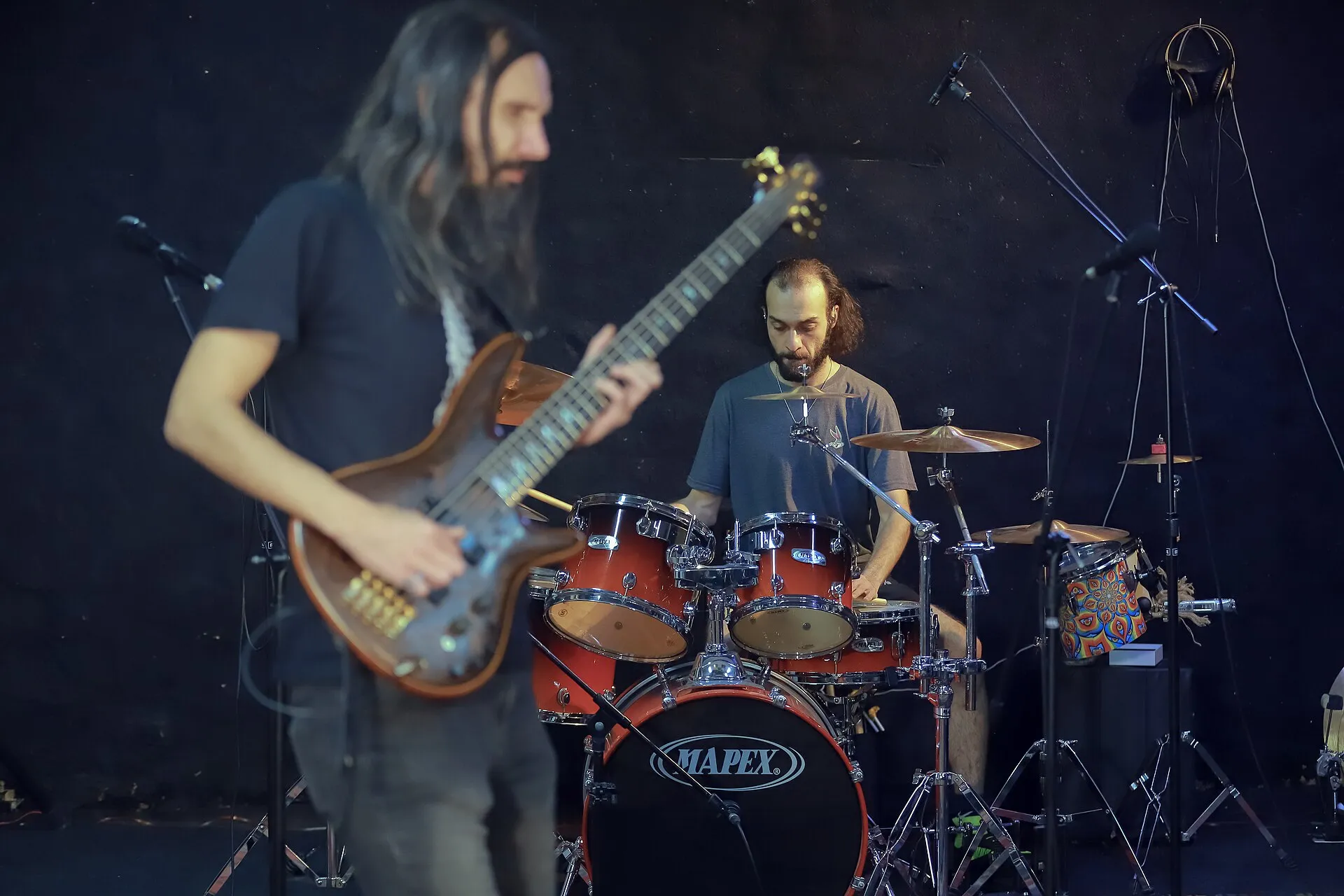
Place the speakers high up (on stands or fixed to the wall), aimed toward the center of the room, and away from the walls to limit the muddy lows. The goal is that each musician hears the voices without having to strain their ear.
Arrange the musicians in a circle or a semicircle in the room, each facing the others for eye contact. The drums in the center or on one side, the amps aimed toward the inside of the circle rather than toward the walls. A room with a little furniture, rugs or acoustic panels sounds better than a bare and reverberant room.
How to adjust the volumes at a rehearsal?
Adjust the volumes from the loudest to the quietest: the drums give the base level, the amps lock onto it, then the PA system for the voices comes on top without covering. Each musician must hear their own voice or instrument without straining.
The voice is almost always the weak link: if the singer strains, the whole band goes up, and the result becomes confused. A good reflex is to do a quick sound check at the beginning of the rehearsal: each person plays a little alone, then everyone together, adjusting the levels so that the voices remain clear.
How to sound the voice at a rehearsal?
To sound the voice at a rehearsal, use a cardioid dynamic microphone for the singer, connected to a channel of the mixing console with a little equalization (cut the useless lows, add a touch of presence). The volume must allow the singer to make themselves heard without shouting.
If several musicians sing, plan one microphone per singer or shared microphones with well-placed stands. Dynamic microphones are recommended: they are rugged, avoid feedback and support high sound pressure levels. To choose, our guide on dynamic and condenser microphones explains the differences.
What you need to remember
- ✔ Voice first: the PA system of a rehearsal is above all used to make the voices heard.
- ✔ Speakers high up: on stands, aimed toward the band, away from the walls.
- ✔ Quick sound check: adjust the levels at the beginning of the rehearsal, from the loudest to the quietest.
- ✔ Protect your ears: reasonable volume and adapted earplugs if the band plays loud.
- ✔ Dynamic microphones: rugged and feedback-resistant for the voices at a rehearsal.
How to sound the drums at a rehearsal?

At a rehearsal, the acoustic drums are heard naturally: no need to sound them, except if they are too quiet or too loud compared to the rest. If they cover everything, ask the drummer to play less loud or install an acoustic screen around the drums.
If the drums are too quiet (in a large room or with a heavily amplified band), a kick drum microphone and possibly a microphone above the cymbals can bring them out in the PA system. For an electronic drum kit, simply connect its output to the mixing console or to a dedicated amplifier.
How to sound the instruments at a rehearsal?
For the guitar and the bass, the amplifier is generally the best PA system at a rehearsal: no need to pick it up on the console if the volume is balanced. On the other hand, acoustic instruments (acoustic guitar, piano, violin) or keyboards often deserve to be amplified to be heard.
Keyboards and computer sounds connect directly to the mixing console via jack cables or an audio interface. For acoustic instruments, a microphone or a piezo pickup does the job. The idea is to give each musician a comfortable volume without creating a battle of levels.
How to sound a rehearsal without feedback?
Feedback at a rehearsal is prevented as at a concert: place the speakers in front of the microphones, keep a reasonable volume and use cardioid microphones. If a whistle starts, lower the channel concerned rather than the general volume.
In a small room, feedback appears quickly because the walls reflect the sound. Reduce the reverberation with rugs, curtains or panels, and move the microphones away from the speakers. Our article on preventing feedback details the good reflexes, identical at a rehearsal.
What budget to sound a rehearsal?
The budget is divided into three ranges. At the entry level, a versatile speaker and a microphone are enough to make the voices of a small band heard. In the mid range, you add a second speaker, a better console and several microphones for real comfort. At the top of the range, you enter gear that can also be used at concerts.
For a band that rehearses once a week, the entry level or the mid range is more than enough. If the same gear must be used at concerts, invest in a slightly more powerful and transportable PA system. Renting can also be an option to test gear before buying.
🧑💼 The Green Musicians tip
Rehearse as you will play: if you use a PA system at concerts, rehearse with the same PA system and the same base settings. Set up, do the sound check, then do not touch the levels anymore during the rehearsal: you will learn to play in conditions close to live.
What mistakes should you avoid when sounding a rehearsal?
The classic mistakes at a rehearsal are easy to avoid. Do not raise the volume endlessly (it is tiring and useless), do not let an instrument cover the voices, and do not neglect the acoustics of the room.
Also think about the hearing: a rehearsal that is too loud damages the ears irreversibly. If you have to shout to make yourself heard, lower everyone by a notch. Finally, store and protect your gear: cables and microphones are the first to suffer at a rehearsal.
FAQ - Sounding a band rehearsal
What speaker power for a rehearsal?
For a medium-sized room, two speakers of 200 to 400 watts RMS are enough. The quality of the sound and the placement count more than the raw power in a small space.
Do you need a mixing console to rehearse?
Yes, as soon as you sound several voices or instruments. A small console of 6 to 12 channels allows you to adjust each source independently and to obtain a balanced sound.
How to make the singer hear themselves at a rehearsal?
Give them a microphone connected to the PA system, adjust the volume so that their voice passes above the instruments, and reduce the general volume if necessary. A well-placed monitor or speaker also helps.
Can you rehearse without a PA system?
Yes, for an acoustic band or a moderate volume. As soon as the drums and the amps cover the voices, a PA system becomes necessary for efficient work.
How to protect your hearing at a rehearsal?
Keep a reasonable volume, take breaks, and wear earplugs adapted to musicians if the band plays loud. Hearing does not repair itself.
How to sound a band that rehearses in a garage?
Start by damping the room (rugs, panels or acoustic foam), place the speakers high up and adjust the volumes step by step. A bare garage sounds very loud and very confused: the acoustics are your first project.
There you go! We hope this article helped you understand how to sound a band rehearsal. All you have to do now is browse Green Musicians to find the gear you need at the best price.
We offer you a complete catalog of music gear featuring brands from all over the world such as Mackie, Studiomaster, Proel, Peavey, Alto and many more. Whether you are an amateur or a professional musician, our marketplace is designed to offer you the best of music.
Green Musicians is also the music marketplace where everyone can sell or buy music gear with confidence: new, refurbished and used instruments, but also software, plugins, sheet music and samples.
For any question or comment about this article, or if you would like to suggest an article topic, feel free to leave a comment below.

 What is a looper and how to use it?What is a looper and how to use it? The loop principle, choosing a model, practicing, composing and playing live: the complete beginner's guide.Read more
 How long does it take to learn the drums?How long does it take to learn the drums: first grooves, first songs and independence. The realistic benchmarks and the right practice rhythm.Read more
 Vestax: Japanese legend of DJ equipment and vinyl turntablesVestax, founded in Tokyo in 1977, made DJing history with its revolutionary vinyl turntables and legendary mixers. A look back at the legacy of a cult brand that continues to inspire DJs around the world.Read more
 Hagstrom: Swedish guitars and basses since 1958Hagstrom, Swedish guitar excellence since 1958.Read more
 Altamira: classical and flamenco guitars inspired by Spanish traditionAltamira offers classical, flamenco, gypsy jazz guitars and historical replicas inspired by Spanish tradition. From beginner to concertist, discover authentic lutherie at the right price.Read more
 NoiseWorks VoiceAssist: cleaner vocals in less timeWhat if the next real upgrade to your studio were not a new microphone or a preamp, but time? That is the question NoiseWorks raises with VoiceAssist, a plugin that tackles the least creative part of vocal work: cleanup. Background noise, room reverb,Read more
 How to sound a band rehearsal?How to sound a band rehearsal: gear, speaker placement, volume balance and voice amplification for effective rehearsals that protect your hearing.Read more
 How to get a good stage monitor mix?How to get a good stage monitor mix: gear, console connections, volume settings without feedback and placement tips for musicians.Read more
 Which PA amplifier for a room of 100 people?Which PA amplifier for a room of 100 people: power, speaker types, placement and budget advice to sound your venue properly.Read more
 How to connect your computer to a PA system?How to connect your computer to a PA system: audio interface, cables and console settings, with the fallback solutions and the mistakes to avoid.Read more
Leave a comment