Studio One: the rising PreSonus DAW in music production
When a new music software arrives on a market dominated by giants established for decades, it needs a strong argument. Studio One, developed by PreSonus, rose to this challenge brilliantly. Since its first version released in 2009, this DAW has carved out a choice place among music production tools, winning people over with its modern interface, quick learning curve and all-in-one philosophy. Designed by a team from the world of computer music, Studio One embodies the new generation of digital audio workstations: powerful, elegant and accessible. Let us dive into the history of this rising software, its features that make the difference, and see how to choose it well against the competition.
History: the new generation of DAWs
2009, the birth of a challenger
Studio One was born from PreSonus's desire, an American manufacturer renowned for its audio interfaces and mixing consoles, to offer its own production software. To lead this ambitious project, the company called on experienced developers, some of whom came directly from the world of Steinberg, the publisher of Cubase. This lineage is visible in the DNA of the software: Studio One takes the best ideas of the historic DAWs, modernizes them and strips them of the complexity accumulated over the years. From its release, the software impressed with its fluidity, its stability and its clean interface, designed for today's musicians.
A DAW designed as a complete studio
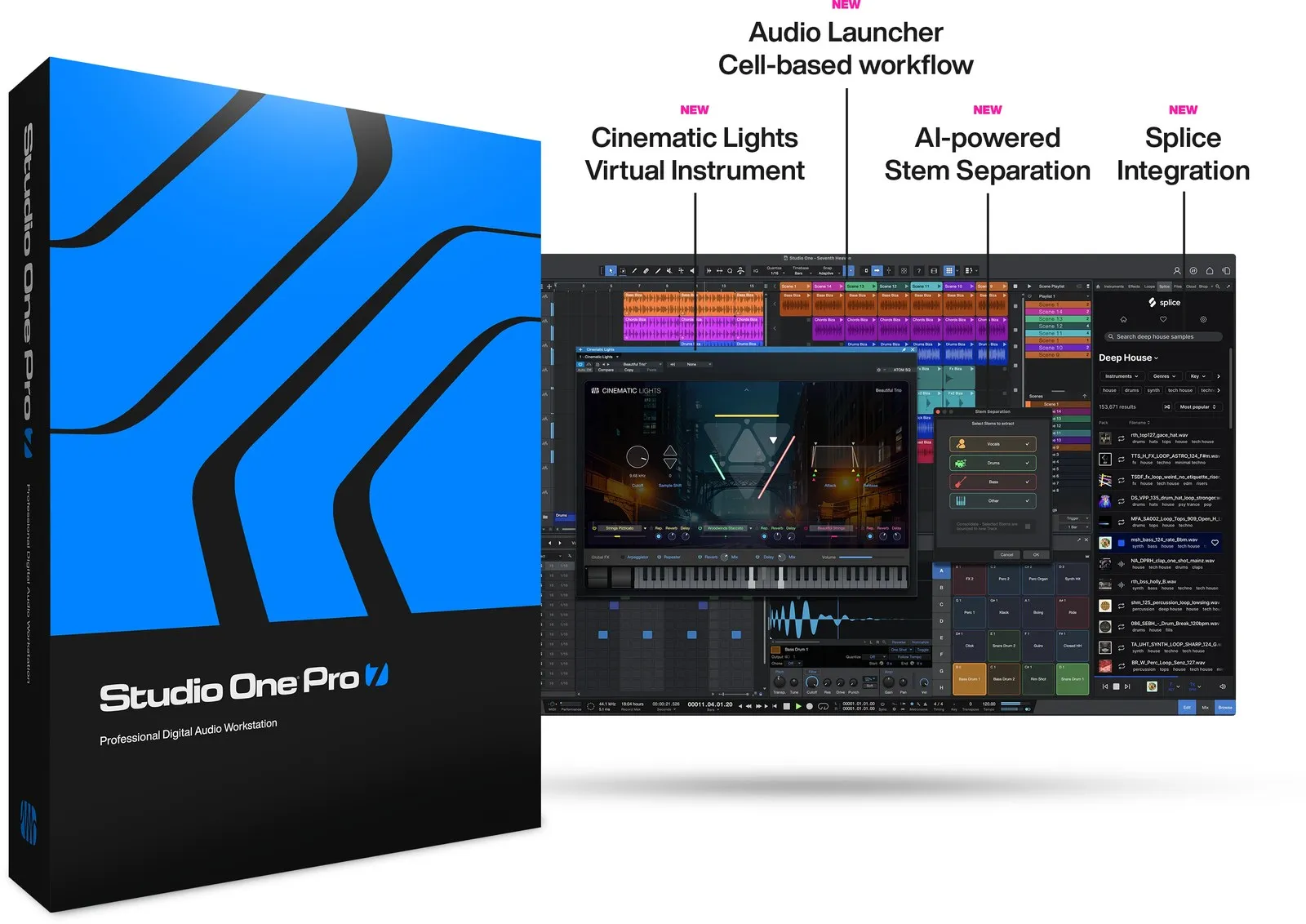
What has set Studio One apart from its competitors from the start is its integrated approach. Where many software only record and mix, Studio One natively includes tools that often remain paid options elsewhere: a complete mastering editor with its dedicated page, a deep integration of the Melodyne vocal correction software, and a coherent project management from the first recording to the final file. This all-in-one philosophy has won over many producers who want to work in a single environment, without juggling between several applications. The successive versions, from Studio One 2 to Studio One 7, have enriched the software without ever compromising its legendary responsiveness.
The features that make the difference
An exemplary drag-and-drop fluidity
Studio One has made drag-and-drop one of its founding principles. Instruments, effects, loops, audio files: everything is dragged and dropped into the project with disconcerting simplicity. You can drag an entire track into a virtual instrument to turn it into a playable sound, or drop an effect onto several channels simultaneously. This intuitive approach considerably reduces the learning time, which explains why many beginners choose Studio One as their first DAW, while remaining deep enough for the most demanding professionals.
Integrated Melodyne for vocal correction
Studio One is the only major DAW to natively integrate a complete version of Melodyne, the reference pitch correction software. As soon as an audio track is recorded, you can display the sung notes in the form of blobs and correct them, move them or transform them with surgical precision, without opening an external window. This deep integration, combined with the time-stretch and transient detection tools, makes Studio One a first-class choice for vocal work, whether in pop, rap or variety music.
An expressive mixing console and Fat Channel
Studio One's mixing console is both complete and readable. Each channel has inserts, sends, automation and a dedicated equalizer. The emblematic feature of the software remains the Fat Channel, which reproduces the architecture of PreSonus consoles: you stack processing modules inspired by studio classics, compressors, equalizers and limiters, to sculpt the sound of each track with immediate character. Recent versions have enriched this palette with new modules and extended control, making mixing in Studio One both a creative and efficient experience.
An integrated mastering page
The most remarkable originality of Studio One remains its mastering page, accessible in one click. The whole project appears there as an album, with its tracks aligned, ready to be chained and processed. You apply compression, equalization and limiting on the master, you set the transitions between tracks, and you export the complete album with polished metadata. This function, normally reserved for specialized software, makes Studio One a truly all-in-one production and finishing solution, appreciated by independent artists who manage their own release.
Who uses Studio One?
Studio One has won over a very varied audience, from electronic music producers to mastering studios, including pop artists and rock bands. Its quick learning curve makes it a natural choice for musicians who want to record their ideas without getting lost in a complex interface, while its technical depth appeals to sound engineers looking for a modern tool. Many mastering studios have adopted Studio One for its dedicated page, and the user community keeps growing, driven by active forums and regular updates that testify to PreSonus's attentiveness to its users. If you are starting out in computer music, note that Studio One exists in a free version called Studio One Prime, perfect for discovering the software before moving on to the complete editions.
Studio One against the other DAWs: choosing well
The choice of a DAW is a personal decision, dictated by your way of working, your musical style and your level. Studio One stands out for its balance between power and simplicity, but other software deserves your attention depending on your needs. Steinberg's Cubase, the German veteran, excels in MIDI programming and composition, while Pro Tools remains the absolute reference of professional recording studios, particularly for mixing and mastering. To help you compare, here are some product pages to consult:
Whatever your choice, know that all these DAWs work with plugins in the VST format, which allows you to build your own processing chain. Emulations of legendary consoles such as the Waves SSL 4000 Collection integrate perfectly into Studio One and enrich your mixing with an authentic vintage character. And if you are looking for a DAW with a modular and innovative philosophy, take a look at Bitwig Studio Essentials, a modern alternative particularly appreciated in electronic music.
Why choose Green Musicians
Green Musicians brings together in a single marketplace the music software, instruments and plugins of the biggest global brands. Whether you opt for Studio One, Cubase, Pro Tools or another DAW, you will find there a rich catalog, authentic products and expert support at every stage of your music project.
- A wide choice of music software, new, refurbished or second-hand, to find the DAW suited to your needs and budget.
- Legitimate licenses and verified products, with a responsive after-sales service that supports you if you have any questions.
- A platform designed by and for musicians, where you can also sell or buy gear with complete confidence, from instruments to plugins.
Studio One embodies the new generation of DAWs: modern, fluid and complete, it proves that it is still possible to shake up a market dominated by historic players. Whether you are a curious beginner or an established producer, it fully deserves its place in your virtual studio.
And there you have it! We hope this article made you want to learn more about the world of music production. All that is left to do is browse Green Musicians to find the gear of your dreams at the best prices on the Internet.
We offer a complete catalog of music gear featuring brands from all over the world such as Fender, Gibson, Martin, Taylor, Ibanez and many more. Whether you are an amateur or a professional musician, our marketplace is designed to bring you the best of music.
Green Musicians is also the music marketplace where everyone can sell or buy music gear with complete confidence: new, refurbished and second-hand instruments, but also software, plugins, sheet music and samples.
If you have any questions or comments about this article, or if you would like to suggest a topic for an article, feel free to leave a comment below.

 What is a looper and how to use it?What is a looper and how to use it? The loop principle, choosing a model, practicing, composing and playing live: the complete beginner's guide.Read more
 How long does it take to learn the drums?How long does it take to learn the drums: first grooves, first songs and independence. The realistic benchmarks and the right practice rhythm.Read more
 Vestax: Japanese legend of DJ equipment and vinyl turntablesVestax, founded in Tokyo in 1977, made DJing history with its revolutionary vinyl turntables and legendary mixers. A look back at the legacy of a cult brand that continues to inspire DJs around the world.Read more
 Hagstrom: Swedish guitars and basses since 1958Hagstrom, Swedish guitar excellence since 1958.Read more
 Altamira: classical and flamenco guitars inspired by Spanish traditionAltamira offers classical, flamenco, gypsy jazz guitars and historical replicas inspired by Spanish tradition. From beginner to concertist, discover authentic lutherie at the right price.Read more
 NoiseWorks VoiceAssist: cleaner vocals in less timeWhat if the next real upgrade to your studio were not a new microphone or a preamp, but time? That is the question NoiseWorks raises with VoiceAssist, a plugin that tackles the least creative part of vocal work: cleanup. Background noise, room reverb,Read more
 How to sound a band rehearsal?How to sound a band rehearsal: gear, speaker placement, volume balance and voice amplification for effective rehearsals that protect your hearing.Read more
 How to get a good stage monitor mix?How to get a good stage monitor mix: gear, console connections, volume settings without feedback and placement tips for musicians.Read more
 Which PA amplifier for a room of 100 people?Which PA amplifier for a room of 100 people: power, speaker types, placement and budget advice to sound your venue properly.Read more
 How to connect your computer to a PA system?How to connect your computer to a PA system: audio interface, cables and console settings, with the fallback solutions and the mistakes to avoid.Read more

Leave a comment