Which microphone for recording vocals? The complete guide
Recording vocals is the art of capturing emotion with fidelity. Whether for singing, a podcast, narration or voice-over, the choice of microphone determines 80% of the final result. A bad microphone can never be fixed at the mixing stage. But between condenser, dynamic, ribbon, USB and XLR, it's hard to find your way. This guide gives you the keys to choosing the right microphone based on your use, your voice and your budget.
Quick summary
Condenser or dynamic: which one for vocals?
This is the first question to ask. These two technologies capture sound differently, and the choice depends on your voice, your room and your use.
The condenser microphone uses a thin, light diaphragm, very sensitive to acoustic pressure variations. It captures more detail, transients, and the subtle nuances of the voice. Its high sensitivity requires an acoustically treated room — otherwise, it also picks up reflections, street noise and the computer fan. It is the reference microphone for studio vocals, voice-overs and anything that requires precision.
The dynamic microphone uses a heavier diaphragm, moving in a magnetic field. Less sensitive, it captures less detail but better tolerates high sound levels and untreated environments. It is the microphone for live performances, podcasts in untreated rooms, and powerful voices (rap, metal, screamed vocals). It naturally rejects part of the ambient noise.
| Criterion | Condenser | Dynamic |
|---|
| Sensitivity | High | Moderate |
| Detail | Excellent | Good |
| Ambient noise rejection | Low | Good |
| Requires power | Yes (phantom 48V) | No |
| Ideal for | Studio vocals, voice-over | Live, podcast, rap |
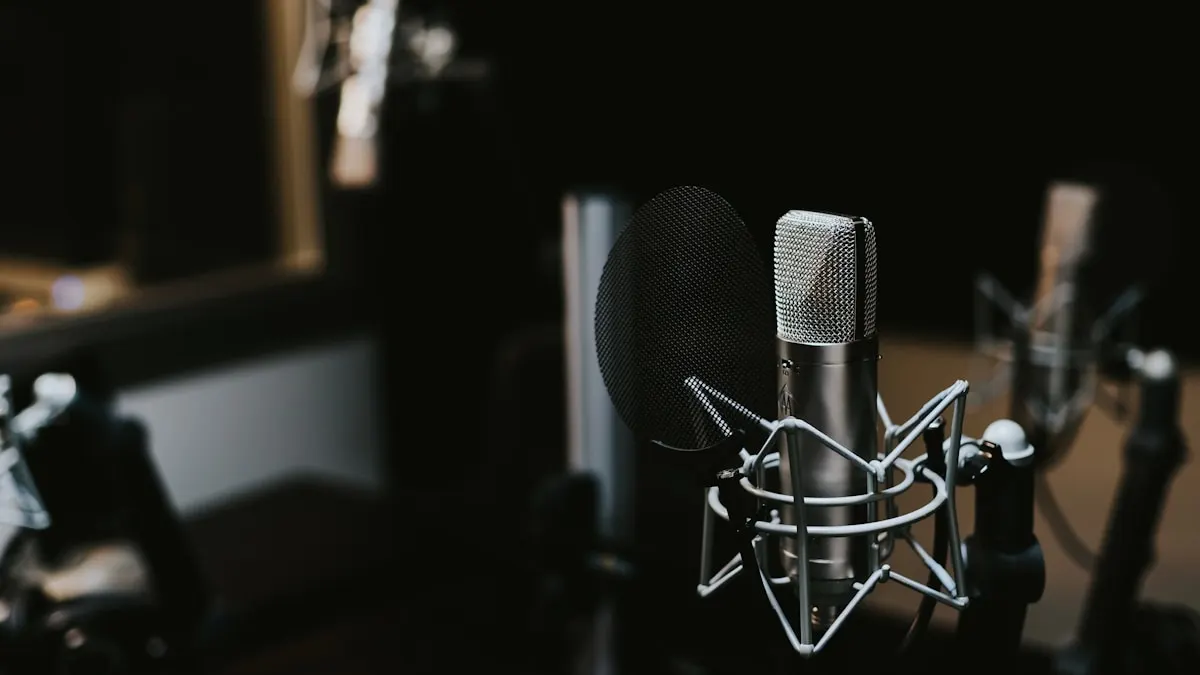
Condenser microphones for vocals: the detail that changes everything
The large-diaphragm condenser (25 mm or more) is the number one choice for recording vocals in the studio. Why? Because its thin diaphragm captures details that the human ear can barely perceive — the breath of a consonant, the grain of a voice, the resonance of a chest cavity. These details make the difference between an amateur recording and a professional one.
The Neumann TLM 103 has become a reference in this field. Its large-diaphragm capsule offers an extended frequency response (20 Hz - 20 kHz) with a slight boost in the high frequencies that brings clarity and presence to the voice. Its extremely low self-noise (7 dB-A) makes it a precision tool for the most demanding recordings. At around 1,200 EUR refurbished at Green Musicians, it is an investment that lasts decades.
For a tighter budget, the Rode NT1 Gen5 offers a remarkable value for money. Fifth generation, 4 dB self-noise, 1-inch capsule — Rode hit hard. You get 90% of a Neumann quality for 25% of the price. It is the microphone I systematically recommend to a musician starting a home studio seriously.
The Audio-Technica AT 2050 offers an interesting feature: it is multi-pattern (cardioid, omnidirectional, bidirectional). This allows you to adapt the capture to the situation: cardioid for a solo voice, omni for a group around the microphone, bidirectional for a face-to-face duo. A versatile microphone that covers all scenarios.
Dynamic microphones for vocals: when simplicity wins
Do not underestimate the dynamic. In an untreated room — that is, 95% of home studios — a good dynamic can give better results than a condenser that picks up everything, including the room flaws.
The Sennheiser E 835-S is a vocal dynamic designed for singing. Its frequency response is optimized for the human voice, with a presence in the upper-mids that helps the voice cut through a mix. The built-in mute switch (the "S" in its name) is handy for sessions where you need to speak between takes. Robust, reliable, it works without phantom power — plug it into your interface and you are good to go.
The Shure Beta 87A is an interesting hybrid: a small-diaphragm condenser in a handheld format. It combines the clarity of a condenser with the robustness of a dynamic. Ideal for someone who wants to record in the studio AND do live performances with the same microphone.
Positioning: how to place your microphone for vocals
The most expensive microphone in the world will give a mediocre result if poorly positioned. Here are the essential rules:
- Distance: 10 to 15 cm from the mouth for a condenser, 5 to 10 cm for a dynamic. Too close = proximity effect (exaggerated bass). Too far = room resonance in the recording.
- Angle: slightly above the mouth, pointing toward the nose. This reduces plosives (the "P" and "B" sounds that blast the capsule) while keeping the signal clear.
- Pop filter: essential with a condenser. Place it 5 cm in front of the capsule. A simple nylon screen is sufficient for moderate vocals.
- Treatment: if your room is not treated, move the microphone closer (5 cm) and use a dynamic. The rear rejection of the cardioid pattern will eliminate a large part of the reflections.
Budget: how much to spend on a vocal microphone?
The market can be divided into three tiers:
Under 200 EUR: the territory of entry-level dynamics and budget condensers. A Sennheiser E 835-S or a used Rode NT1 will do wonders. Do not buy a new condenser under 150 EUR — the capsule quality will be disappointing.
200 to 600 EUR: the sweet spot. Rode NT1 Gen5 new, Audio-Technica AT 2050, or a used Neumann in perfect condition. This is the range where the value for money is best. A 400 EUR microphone, well used, will give results nearly identical to a 2,000 EUR microphone in a mix.
Above 600 EUR: you enter the territory of Neumann TLM 103, AKG C414, and other references. The difference is subtle — a more natural voice grain, lower self-noise, better longevity. If you record professionally, the investment is justified.

FAQ: your questions about microphones for vocals
Do you necessarily need an audio interface with an XLR microphone?
Yes. An XLR microphone delivers a very weak signal (mic level) that requires a preamp to be usable. The audio interface contains this preamp as well as the analog-to-digital converter. Check out our guide Which audio interface for beginners? to choose the right interface.
Can a USB microphone replace an XLR microphone?
For a podcast or video conference, yes. For quality music recording, no. The USB microphone integrates its own converter, generally of inferior quality to a good audio interface. Moreover, it cannot use an external preamp. For music, stick with XLR.
What is the difference between a cardioid and an omnidirectional microphone?
The cardioid captures sound mainly in front of the microphone and rejects the rear. The omnidirectional captures in all directions. For a solo voice, the cardioid is preferable because it isolates the voice from ambient noise.
Do you need to treat your room to record vocals?
Not necessarily with a dynamic, but strongly recommended with a condenser. A few absorptive panels behind the singer and a treated ceiling above are enough to transform a recording. To go further on this topic, check out our guide How to choose a studio microphone?.
Summary of key points
- Condenser for detail and clarity in a treated studio
- Dynamic for robustness and untreated rooms
- Quality budget: Rode NT1 Gen5 (~300 EUR)
- Absolute reference: Neumann TLM 103 (~1,200 EUR)
- Distance: 10-15 cm for condenser, 5-10 cm for dynamic
- Pop filter essential with a condenser
- XLR audio interface mandatory for optimal quality
Conclusion
There is no universal "best microphone" — there is the best microphone for your voice, your room and your budget. A condenser like the Rode NT1 Gen5 in a treated room will give you professional results from 300 EUR. A dynamic like the Sennheiser E 835-S in an untreated bedroom can sound incredibly good too. The key is to understand what your voice and your environment demand, then choose the right tool. And do not forget: the microphone is only the beginning. A good audio interface, good positioning and a properly treated room matter just as much.
Ready to find the perfect mic for your voice?
Discover our selection of studio microphones — new, refurbished and used
View all microphones

 What is a looper and how to use it?What is a looper and how to use it? The loop principle, choosing a model, practicing, composing and playing live: the complete beginner's guide.Read more
 How long does it take to learn the drums?How long does it take to learn the drums: first grooves, first songs and independence. The realistic benchmarks and the right practice rhythm.Read more
 Vestax: Japanese legend of DJ equipment and vinyl turntablesVestax, founded in Tokyo in 1977, made DJing history with its revolutionary vinyl turntables and legendary mixers. A look back at the legacy of a cult brand that continues to inspire DJs around the world.Read more
 Hagstrom: Swedish guitars and basses since 1958Hagstrom, Swedish guitar excellence since 1958.Read more
 Altamira: classical and flamenco guitars inspired by Spanish traditionAltamira offers classical, flamenco, gypsy jazz guitars and historical replicas inspired by Spanish tradition. From beginner to concertist, discover authentic lutherie at the right price.Read more
 NoiseWorks VoiceAssist: cleaner vocals in less timeWhat if the next real upgrade to your studio were not a new microphone or a preamp, but time? That is the question NoiseWorks raises with VoiceAssist, a plugin that tackles the least creative part of vocal work: cleanup. Background noise, room reverb,Read more
 How to sound a band rehearsal?How to sound a band rehearsal: gear, speaker placement, volume balance and voice amplification for effective rehearsals that protect your hearing.Read more
 How to get a good stage monitor mix?How to get a good stage monitor mix: gear, console connections, volume settings without feedback and placement tips for musicians.Read more
 Which PA amplifier for a room of 100 people?Which PA amplifier for a room of 100 people: power, speaker types, placement and budget advice to sound your venue properly.Read more
 How to connect your computer to a PA system?How to connect your computer to a PA system: audio interface, cables and console settings, with the fallback solutions and the mistakes to avoid.Read more
Leave a comment