Do you need to sound a function room, a restaurant or a small gymnasium for around 100 people, and are you wondering which PA amplifier to choose? The good news: sounding 100 people does not require a large installation. What matters most is adapted power, well-placed speakers and a minimum of settings. Here is the guide to choosing without making a mistake.
Which PA amplifier for a room of 100 people?
For a room of 100 people, two powered speakers of 300 to 600 watts RMS each are enough in most cases. Powered speakers include their own amplification: they simplify the installation and avoid having to buy a separate power amplifier. For amplified music with a lot of bass, add a subwoofer.
The real power needed depends mainly on the type of music and the level of ambient noise. A dance evening requires more power than a speech or an acoustic concert. For 100 people, the key is not to have an enormous amount of watts, but to have quality speakers that spread the sound properly.
Powered speakers or passive speakers with a separate amplifier?
Powered speakers are the simplest choice for most users: each speaker contains its amplifier and its crossover, you just connect it to a mixing console and to the mains. Passive speakers require an external power amplifier and speaker cables, but they offer more flexibility and more upgrade possibilities.
For a room of 100 people, powered speakers are recommended: they are easy to transport, to install and to troubleshoot. If you already own a power amplifier or if you plan a fixed installation, passive speakers remain a relevant option. Before buying, read our guide on sounding a small concert: the logic is the same for a room of 100 people.
How much power do you need to sound 100 people?
For 100 people, plan on between 300 and 600 watts RMS per speaker for amplified music, and a little less for voice only. The RMS power (the real continuous power) is the figure that matters: beware of the advertised peak powers that do not reflect the real handling of the speaker.
Remember that doubling the power does not double the perceived volume: you need about ten times more power to get the impression of a sound twice as loud. Better efficient speakers (with a good sensitivity) than powerful but inefficient speakers. The quality of the drivers and of the subwoofer counts more than the number of advertised watts.
Which type of speakers for a room of 100 people?
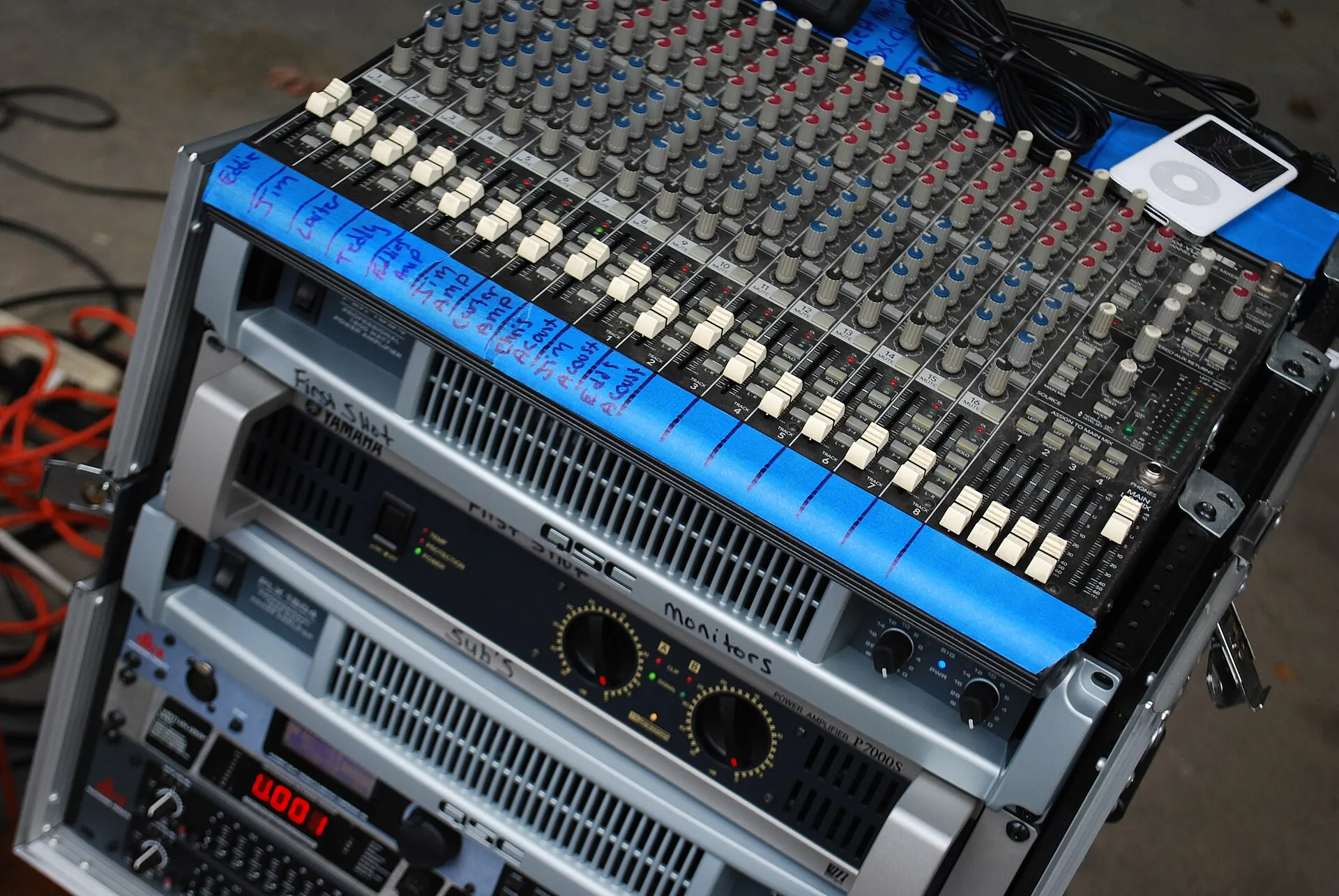
For a room of 100 people, two types of speakers dominate: column speakers (vertical towers with several drivers) and satellite speakers placed on stands with a subwoofer. Columns are discreet, modern and spread the sound very evenly; satellites on stands with a subwoofer are more traditional and often more powerful in the lows.
Column speakers are ideal for weddings, restaurants and conferences: their design is elegant and their vertical spread controls the sound well. Satellite plus subwoofer systems are better suited to concerts and dance evenings where the bass must carry. Brands like Mackie or Studiomaster offer solutions adapted to small and medium rooms.
Do you need a subwoofer for 100 people?
A subwoofer is recommended if you play music with a lot of bass: DJ set, pop, current music. For voice only, a speech or an acoustic concert, two speakers without a subwoofer are generally enough.
The subwoofer brings the depth and the weight that make the difference between a "flat" sound and a "full" sound. It also relieves the main speakers of the lows, which allows them to play louder and cleaner in the mids, where the intelligibility of the voices lives. If your budget allows it, a small subwoofer really changes the perception of a room of 100 people.
Which mixing console to go with a PA amplifier?
To sound 100 people, a small mixing console of 8 to 12 channels is enough: two channels for the main microphones, one or two for the instruments, one for a music player. Compact digital consoles offer built-in effects and a better sound management.
If you connect a computer or a music player directly, a console with a USB input or dedicated stereo inputs makes life easier. For speeches, a wireless microphone is often more practical than a microphone on a stand. The essential setting remains the gain: each channel must be set so that the indicator reaches the green without climbing into the red.
🧑💼 The Green Musicians tip
Prefer quality over power: for 100 people, two good powered speakers of 400 watts RMS, well placed, will sound better than a large cheap installation pushed to the maximum. Invest in renowned speakers and a quality microphone, that is where the result is decided.
How to place the speakers for a room of 100 people?
Place the speakers on each side of the area to be sounded, at ear height of the audience or slightly above, and aimed toward the audience. Avoid the corners of the room, which amplify the lows in a disorderly way.
For a rectangular room, install the speakers near one of the short sides, aimed at the other end. If a passage crosses the room, place the speakers so as to cover the largest possible surface. Raise the speakers with stands so that the sound passes above the heads of the first spectators and reaches those at the back.
How to set up a PA amplifier simply?
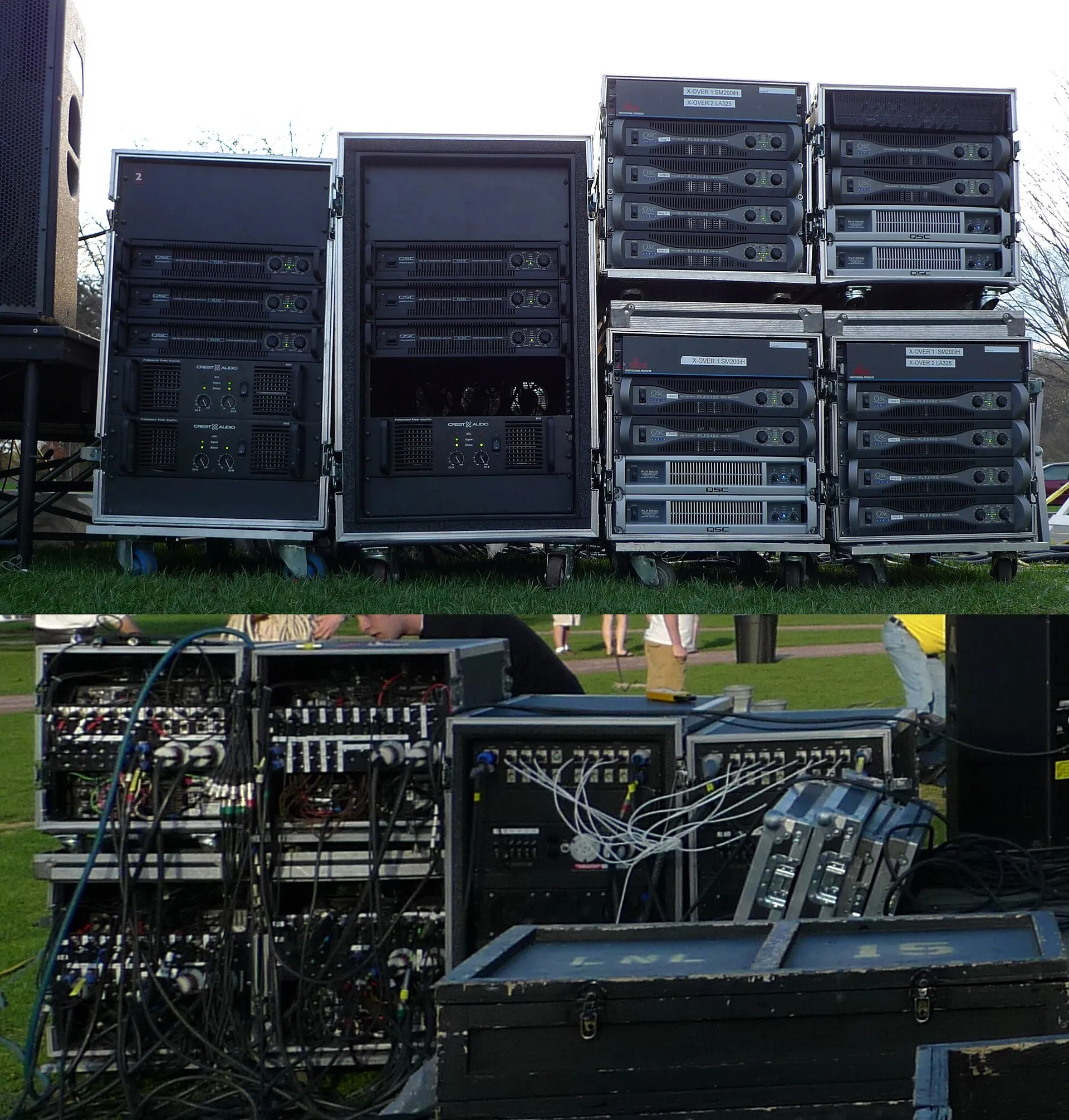
First set all the volumes to the minimum, connect the sources, then raise the channels gradually one by one. Start with the voice or main music channel, adjust the gain for a correct level, then balance the other channels in relation to it.
In equalization, cut the useless lows on the microphones (frequencies below 100 Hz) to avoid the proximity effect and feedback. Add a little presence around 3 to 5 kHz for the clarity of the voices. If the sound is confused, lower rather than raise: a clean sound at a moderate volume fills a room better than a saturated sound.
What budget for a PA system for 100 people?
The budget is divided into three ranges. At the entry level, two simple powered speakers and a small console make it possible to sound occasional events. In the mid range, the speakers gain in power, clarity and reliability, often with the possibility of a subwoofer. At the top of the range, you enter durable professional gear, with protection processors and a superior sound quality.
For a room of 100 people, the most profitable purchase is often a column system or two satellites with a subwoofer in the mid range. If you rarely sound events, renting can be more economical than buying. Always compare the efficiency and the perceived quality, not only the advertised power.
What mistakes should you avoid when sounding a room of 100 people?
The classic mistakes are easy to avoid. Do not put the speakers behind the microphones, do not push the volume before having set the gains, and do not place the speakers in the corners of the room.
Also think about electrical safety: check that the total power does not exceed that of the circuit, use quality power strips and cables in good condition. Finally, do a sound test before the arrival of the audience: walk in the room while a track plays to spot the areas where the sound is weak or unbalanced.
What you need to remember
- ✔ 2 powered speakers: 300 to 600 watts RMS each for 100 people.
- ✔ Subwoofer optional: useful for music with bass, not essential for the voice.
- ✔ RMS power: look at the real continuous power, not the advertised peak power.
- ✔ Raised speakers: on stands, aimed at the audience, never in the corners.
- ✔ Step by step settings: gains first, volume after, never the other way round.
FAQ - PA amplifier for a room of 100 people
How many watts do you need to sound 100 people?
Plan on 300 to 600 watts RMS per speaker for amplified music. For voice only, 200 to 300 watts RMS per speaker are often enough.
Do you need a separate power amplifier?
No, if you choose powered speakers: the amplification is built in. Passive speakers require an external amplifier and speaker cables.
Column speaker or speaker on a stand with a subwoofer?
The column is more discreet and even for events and conferences. The system on stands with a subwoofer is more powerful in the lows for concerts and evenings.
Is one single speaker enough for 100 people?
One single speaker can get you by for a speech, but the sound will be mono and will cover the room poorly. Two speakers offer a balanced stereo coverage and more presence.
Can you connect a microphone directly to a powered speaker?
Some powered speakers have a built-in microphone input with a gain control. This is practical for a speech, but a mixing console remains preferable to manage several sources.
How to avoid feedback with a PA amplifier?
Place the speakers in front of the microphones, reduce the volume if necessary, and use cardioid microphones. A well-used dynamic microphone and a well-placed speaker almost never cause feedback.
There you go! We hope this article helped you understand which PA amplifier to choose for a room of 100 people. All you have to do now is browse Green Musicians to find the ideal sound reinforcement at the best price.
We offer you a complete catalog of music gear featuring brands from all over the world such as Mackie, Studiomaster, Proel, Peavey, Alto and many more. Whether you are an amateur or a professional musician, our marketplace is designed to offer you the best of music.
Green Musicians is also the music marketplace where everyone can sell or buy music gear with confidence: new, refurbished and used instruments, but also software, plugins, sheet music and samples.
For any question or comment about this article, or if you would like to suggest an article topic, feel free to leave a comment below.

 What is a looper and how to use it?What is a looper and how to use it? The loop principle, choosing a model, practicing, composing and playing live: the complete beginner's guide.Read more
 How long does it take to learn the drums?How long does it take to learn the drums: first grooves, first songs and independence. The realistic benchmarks and the right practice rhythm.Read more
 Vestax: Japanese legend of DJ equipment and vinyl turntablesVestax, founded in Tokyo in 1977, made DJing history with its revolutionary vinyl turntables and legendary mixers. A look back at the legacy of a cult brand that continues to inspire DJs around the world.Read more
 Hagstrom: Swedish guitars and basses since 1958Hagstrom, Swedish guitar excellence since 1958.Read more
 Altamira: classical and flamenco guitars inspired by Spanish traditionAltamira offers classical, flamenco, gypsy jazz guitars and historical replicas inspired by Spanish tradition. From beginner to concertist, discover authentic lutherie at the right price.Read more
 NoiseWorks VoiceAssist: cleaner vocals in less timeWhat if the next real upgrade to your studio were not a new microphone or a preamp, but time? That is the question NoiseWorks raises with VoiceAssist, a plugin that tackles the least creative part of vocal work: cleanup. Background noise, room reverb,Read more
 How to sound a band rehearsal?How to sound a band rehearsal: gear, speaker placement, volume balance and voice amplification for effective rehearsals that protect your hearing.Read more
 How to get a good stage monitor mix?How to get a good stage monitor mix: gear, console connections, volume settings without feedback and placement tips for musicians.Read more
 Which PA amplifier for a room of 100 people?Which PA amplifier for a room of 100 people: power, speaker types, placement and budget advice to sound your venue properly.Read more
 How to connect your computer to a PA system?How to connect your computer to a PA system: audio interface, cables and console settings, with the fallback solutions and the mistakes to avoid.Read more
Leave a comment