Seagull is a Canadian acoustic guitar maker and a sub-brand of Godin Guitars, founded in 1982 in La Patrie, a village in Quebec's Eastern Townships. Every Seagull guitar is built in Canada, in Godin's workshops in the Montreal area.
What sets a Seagull guitar apart?
Three design decisions run through every Seagull model, and they explain both the tone and the tuning stability these guitars are known for.
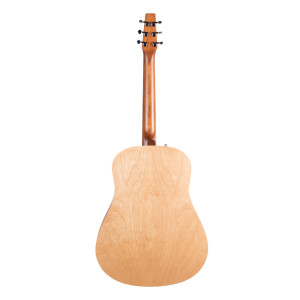
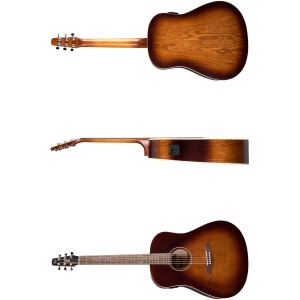
A headstock aligned with the strings
On a conventional acoustic, the tuners sit in two rows of three and the strings break sharply at the nut. Seagull places the tuners roughly in line with the nut, so each string stays almost straight. Less angle means less friction, which translates into tuning that holds better, especially when you play open chords with bends.
A compound-curve top
Almost every acoustic guitar has a flat top. Seagull applies a very slight curve, roughly a seven-metre radius above the soundhole, which flattens progressively towards the bridge. That curve allows a thinner top and lighter bracing while keeping structural rigidity, giving a more responsive instrument that is less prone to the wood sinking around the soundhole.
The brand's founder, Robert Godin, put it this way: to "create a new acoustic design that would simultaneously improve sound and structural integrity."
Solid tops from the entry level up
Seagull does not reserve solid wood for the high end. The S6, the brand's entry-level model, already has a solid cedar or spruce top, which is rare at that price point.
The Seagull ranges available at Green Musicians
The Green Musicians catalogue covers four families, from the study instrument to the stage-ready guitar.
S6 - the entry-level reference
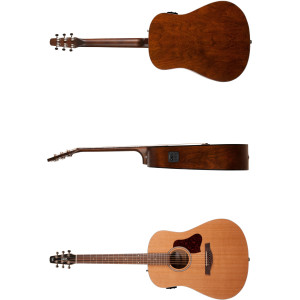
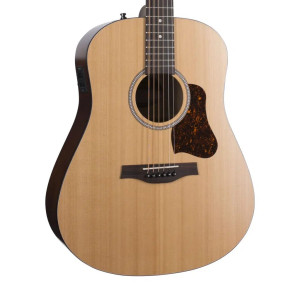
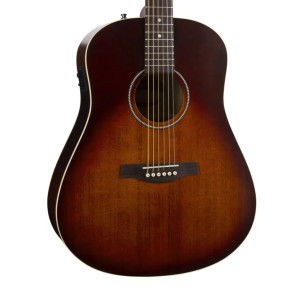
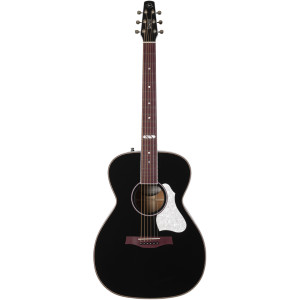
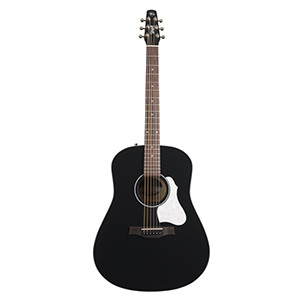
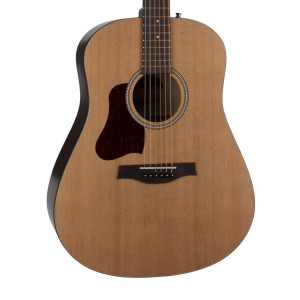
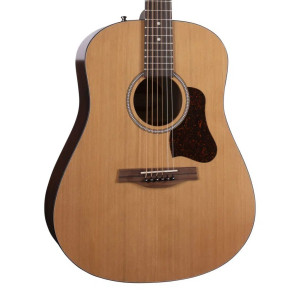
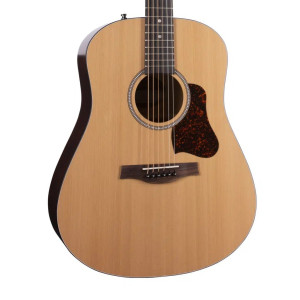
The S6 is the model that made Seagull known. Dreadnought body, solid top, and many variants: Original, Original Slim for smaller hands, Original LH for left-handed players, Classic Black, Burnt Umber, and the Collection 1982 anniversary edition. Several versions come with a Presys II preamp for stage use.
Entourage - the versatile folk format
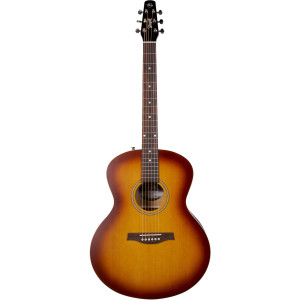
The Entourage uses a more compact folk body, popular with guitarists who sing and play and want an instrument that is easy to hold while seated. The Rustic Burst finish gives it a strong visual character. It comes as Folk and Mini-Jumbo.
Maritime SWS - the solid-wood mid-range
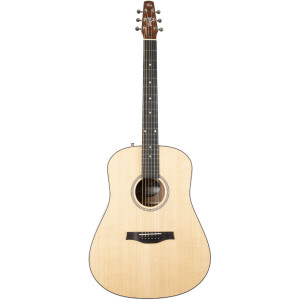
The Maritime SWS steps up a level with selected tonewoods and more detailed construction. These are guitars for players who perform regularly and want an instrument that ages well. Some versions carry a Presys II preamp with a built-in tuner.
M6 and Artist Ltd - the upper series
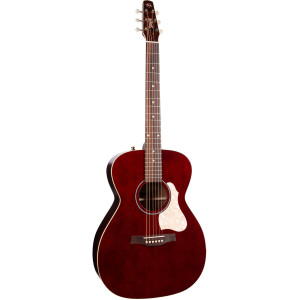
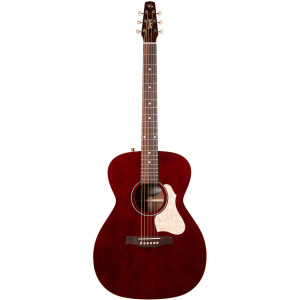
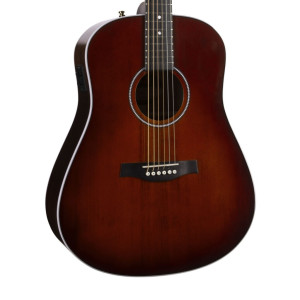
The M6 Limited Red Ruby is a limited dreadnought series with onboard electronics. The Artist Ltd sits at the top of the range: refined finishes, quality electronics and projection designed for both stage and studio.
Seagull range comparison
- S6 - Entry level, dreadnought body: learning and regular practice.
- Entourage - Upper entry, folk and Mini-Jumbo body: singing and playing, seated work.
- Maritime SWS - Mid-range, dreadnought body: rehearsals, gigs, intensive playing.
- M6 - Limited series, dreadnought body: equipped players who want something rarer.
- Artist Ltd - High end, dreadnought body: stage, studio, demanding finish.
Are Seagull guitars made in Canada?
Yes. Seagull is a sub-brand of Godin Guitars, whose workshops are in Quebec, first in La Patrie and then in the Montreal area. Production is Canadian across the whole range, including the entry level.
This matters to a lot of buyers: there is no Seagull series relocated to Asia to hit a price. Cost control comes from design and Godin's vertical integration, not from moving the production site.
Is a Seagull good for a beginner?
A Seagull is an excellent first instrument for a serious player, because it has a solid top where many instruments at the same price use laminate. A solid top vibrates more freely and the guitar gains richness as it ages, which means you avoid replacing it two years later.
The trade-off is that a solid guitar needs some care: it reacts to changes in humidity and temperature. That is not a difficult constraint, it is simply what you accept in exchange for an instrument that resonates.
Solid top or laminated top: what is the difference in sound?
The top is the upper plate of the body, the part that picks up the vibration of the strings. A solid top is cut from a single piece of wood, while a laminated top is made of thin glued layers. A solid top vibrates more freely, giving a more open tone that improves over time; a laminated top is more stable and cheaper to produce.
At Seagull, the entry level is already solid. That is the brand's main argument.
How do you choose between the S6, Entourage, Maritime SWS and Artist Ltd?
The choice starts with use, then with budget. The S6 suits learning and regular practice. The Entourage targets players who want a compact format for singing and playing. The Maritime SWS is for the musician who plays often and wants durability and consistent tone. The Artist Ltd is built for stage and studio, electronics included.
Second criterion: do you need a preamp? If the guitar will be plugged in on stage or recorded direct, choose an equipped version rather than adding a pickup later.
Which player is a Seagull made for?
- Demanding beginner: S6 Original, a solid top from the first purchase and room to progress for years.
- Singer-guitarist: Entourage Folk, compact and comfortable when seated.
- Regular player: Maritime SWS, an instrument that keeps up with rehearsals and gigs.
- Equipped player: M6 Limited, a rarer model with onboard electronics.
- Stage and studio musician: Artist Ltd, with the matching electronics and projection.
- Left-handed player: the S6 Original LH exists in the range, order it ahead of time.
How do you care for and set up a Seagull acoustic guitar?
- Humidity: aim for 45 to 55 % relative humidity. A solid instrument kept in a room that is too dry will see its top sink.
- Heat: never leave the guitar in a car parked in the sun, brace glue joints suffer quickly.
- Strings: change them as soon as they lose their brightness. A badly strung acoustic loses more tone than most players expect.
- Setup: string height and neck relief should be checked at least once a year, more often if the instrument travels.
- Tuning: Seagull's aligned headstock limits drift, but it does not replace tuning before every session.
- Transport: a hard case protects against knocks but also against humidity swings, especially in winter.
Go further
FAQ - Seagull guitars
Are Seagull guitars made in Canada?
Yes. Seagull is a sub-brand of Godin Guitars and all production takes place in Quebec, in Godin's workshops in the Montreal area. There is no Seagull series built in Asia: entry prices come from design and vertical integration, not from relocation.
Which Seagull guitar should you choose as a first instrument?
The S6 Original remains the most logical starting point: solid cedar or spruce top, versatile dreadnought body and an entry price that leaves room for a case. Slim versions suit smaller hands and the LH version is made for left-handed players.
Is a Seagull suitable for a child?
A dreadnought is still a large instrument for a child. Before choosing this format, check that the scale length matches the student's size; a guitar that is too big discourages more than it helps. Format matters more than brand here.
Cedar or spruce top: what is the difference?
Spruce delivers a sharp attack and plenty of brightness, and opens up over years of playing. Cedar produces a warmer, rounder sound from the first weeks, which reassures beginners. Neither is superior, it comes down to tonal preference.
Should you choose a version with a preamp?
If the guitar will be plugged in on stage, recorded direct, or played in a setting where it has to hold its own against other instruments, the electro-acoustic version saves adding a pickup and a preamp later. For purely acoustic use at home, a version without electronics is enough and costs less.
What is Seagull's compound-curve top?
It is a slight curve applied to the top, roughly a seven-metre radius above the soundhole, flattening progressively towards the bridge. The design allows a thinner top and lighter bracing while keeping rigidity, which improves the instrument's response and limits the wood sinking around the soundhole over time.
How do you check the condition of an acoustic guitar before buying?
Check the flatness of the top (it should not have sunk behind the bridge), look at the bridge and nut glue joints, check neck relief by sighting the profile from the headstock, and play every string along the whole neck to spot a fret that buzzes.
Why does a solid guitar need more care?
Because solid wood moves with humidity. A well-maintained solid guitar sounds better than a laminated one, but it copes badly with a room that is too dry or a long stay in a car in full sun. An indoor hygrometer and a hard case solve most of the problem.