Cart
There are no more items in your cart


- Supplier Direct
- -6%
Hora has been building string instruments in Reghin, Romania, since 1950: violins, violas, cellos, double basses, classical guitars and ukuleles. Selected woods, a traditional oil varnish and instruments set up before dispatch. Green Musicians carries 122 Hora references — instruments, cases and bows — shipped through a short supply chain, with sizes from 1/4 to 4/4 to equip a pupil from the very first term.
Hora S.A. has been making string instruments in Reghin, Romania, since 1950. Violins, violas, cellos, double basses, classical guitars and ukuleles come out of the same workshop, built from selected woods and finished with a traditional oil varnish.
The catalogue is organised by playing level — Student, Elite, Academy and Master — and covers sizes from 1/4 to 4/4. Green Musicians carries 122 Hora references: instruments, cases and bows, shipped set up and through a short supply chain.
💡 The essentials
Choosing a Hora means choosing an instrument designed in a European workshop: identified woods, a stable build and a finish that does not chase effect. For a pupil and for a teacher, that means fewer surprises and an instrument that follows several years of practice.
Hora builds in Romania, where woodworking and luthier training are long-established trades. That base makes it possible to offer properly finished string instruments without a relabelling chain: the brand makes what it sells, and the name on the scroll belongs to the workshop that assembled the instrument.
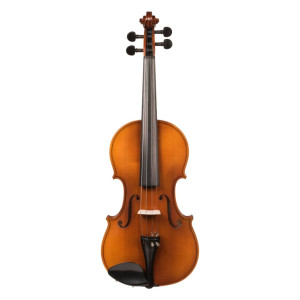
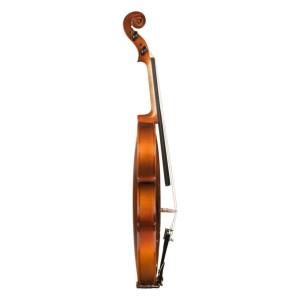
Mid-range models pair a solid spruce top with maple back and ribs, flamed on the upper ranges; ebony appears on the fingerboard and pegs of the most accomplished instruments. Solid spruce carries vibration more freely than a rebuilt panel, maple reflects it and ebony keeps wear even at the contact points.
Hora sorts its catalogue by playing level rather than by price step. Each range matches a stage of learning, with rising demands on wood selection, assembly and finishing time.
The Student range is aimed at beginners. The C110, with its solid spruce top, sums up the brand's approach: even at entry level, the panel that makes the sound stays solid. The instrument answers from the first notes and supports intonation.
Elite accompanies the second or third cycle, when a pupil works on phrasing, dynamics and vibrato: more closely selected woods, finer assembly. Academy targets specialist courses, with more projection for auditions and exams.
The Master range gathers the most accomplished instruments: flamed maple back and ribs, ebony fingerboard and pegs, oil varnish in thin coats. It is intended for advanced players or professionals looking for a second instrument.
Size comes first, before range and before price. An instrument that is too large tires the shoulder and blocks technique; one that is too small limits the sound and forces the arm to compensate.
Measure the outstretched arm from shoulder to the middle of the palm, then compare with the references teachers use: about 60 cm for a 4/4, 57 cm for a 3/4, 52 cm for a 1/2 and 47 cm for a 1/4. The pupil must hold the instrument without lifting the shoulder or leaving first position.
These sizes follow a child's growth, often between six and twelve. The move is decided when the pupil runs out of room on the fingerboard, not at the first growth spurt. When two sizes are possible, the teacher decides: a slightly small instrument plays better than one that tenses the arm.
A cello is chosen seated, between the knees: size depends on leg length and on reaching first position without stretching. Sizes 1/8 to 4/4 follow the same school progression as the violin.
The top receives the bridge's vibration and passes it to the body. Whether it is a solid panel or a stack of plies shapes much of the response, far more than the thickness of the varnish.
A solid panel vibrates as one continuous membrane: it carries upper harmonics, answers dynamics quickly and opens up with playing. That is why the C110 has one at entry level — the instrument gains responsiveness and avoids the muffled tone that discourages beginners.
Laminated tops are more stable when humidity shifts and simpler to produce. On a spare, travel or young-child instrument that stability has real value, without pretending to match a solid panel.
A string instrument asks little, but it asks regularly. A few simple habits keep a Hora stable for years and avoid expensive repairs.
Slacken the string slightly before bringing it up, never pull straight on the peg: that limits wear in the peg hole and the jerks that break strings. On a new instrument, tuning more often during the first weeks is normal.
Rosin leaves a film that dulls the sound and attacks the varnish: a dry cloth after each session is enough. Change a string when it no longer holds pitch or the tone turns dull, and always one at a time so the soundpost stays in place.
🎯 This choice is right for you if...
A string instrument is bought for several years. These are the questions pupils, parents and teachers ask most often.
New guarantees a controlled set-up and an unfatigued top. Second-hand can offer wood that has already opened up, provided bridge, soundpost, pegs and purfling are checked. For a first purchase, new is simpler.
Instruments leave set up, but a fine adjustment after a few weeks of playing is useful: the wood settles, the pegs bed in and string height can be matched to the pupil's comfort.
On top of the instrument come a spare set of strings, a bow suited to the size, rosin and a case. A badly balanced bow hinders a beginner more than a modest, well set-up instrument.
The questions we hear most about Hora instruments and how Green Musicians distributes them.
Yes. Hora S.A. is based in Reghin, Romania, where it has built violins, violas, cellos, double basses, classical guitars and ukuleles since 1950.
Yes. The C110 belongs to the Student range and stands out for its solid spruce top, rare at that price level. It suits the first years, in the size that matches the pupil.
Elite (C200) marks the step to a more expressive instrument. Academy (C300) targets specialist courses with more projection. Master (C400) combines flamed maple, ebony and a long oil finish.
Yes. Hora instruments shipped by Green Musicians leave with the bridge in place, the soundpost positioned, strings fitted and action checked. A fine luthier adjustment remains possible afterwards.
Green Musicians ships from its European warehouse through a short supply chain: fewer intermediaries, short lead times and tracking to delivery, in a case or reinforced packaging.