Epica Audio: creative effect plug-ins that shape a sound instead of correcting it
Epica Audio is a publisher of creative effect plug-ins for music production. The whole range follows one intention: give a sound source character — texture, movement, colour — rather than repair a fault. Where other publishers pile on parameters, this one commits to single controls, sometimes reduced to one knob.
The plug-ins ship as VST3, AU, AAX and LV2, on MAC OS, WIN and LINUX, so the same chain can move from a studio desktop to a live laptop or a Linux machine. Several products claim zero latency and stay usable while recording. Three families sit side by side: texture and movement effects, one-knob shapers (Bande master, HI-FI, Large, LO-FI) and production utilities such as the notepad built into the project.
💡 Key takeaways
- ✔ Publisher: creative effect plug-ins for music production
- ✔ Formats: VST3, AU, AAX, LV2
- ✔ Platforms: MAC OS, WIN, LINUX
- ✔ Philosophy: simple controls, effects built for texture and character
- ✔ Latency: zero on several products, usable while recording
Why does Epica Audio favour simple controls?
An effect is judged by what it makes audible, not by how many faders it shows. By deliberately limiting the parameters, the brand moves the work elsewhere: you pick an intention — more body, more air, more width — then adjust at the margin.
Bande master, HI-FI, Large, LO-FI: four one-knob shapers
Bande master applies tape-inspired saturation: natural compression, fluid curves, harmonic sheen, with no noise or artefacts. HI-FI balances weight in the lows against clarity in the highs. Large works on width, depth and spatial clarity, with a Light mode for transparent stereo expansion, designed to avoid phase problems. LO-FI combines a high-pass filter, a low-pass filter and a distortion engine, from vintage colouration to heavily crushed textures.
One knob does not mean no settings at all
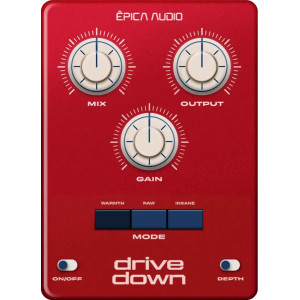
Several products keep the controls that genuinely change the result: Drivedown Distortion II's Depth keeps lows and highs clean as the drive goes up; Mix opens parallel distortion; UFO FILTER II offers an LFO, five waveforms, Drive and Mix; Trinity Eq II manages input and output gain and offers level-matched A/B comparison.
How does the brand handle texture, movement and colour?
Each effect shifts a starting parameter — the type of distortion, a delay's rhythmic grid, the source of a modulation — so it never sounds like the original tool. That is the difference between a corrective plug-in and a character plug-in.
Drivedown Distortion II: three modes, one algorithm
The distortion rests on a single algorithm built on Pi and three modes — Warm, Raw, Insane — running from soft analogue warmth to aggressive fuzz. The weak point of any distortion is the low end: pushed too far, it flattens the bass and leaves the track without a floor. Here Depth protects the lows and highs, and Mix doses the effect in parallel.
Andes Echo II and Feedback Chorus II: rhythm and modulation
Andes Echo II replaces standard quarters and eighths with Latin rhythmic motifs — galop, syncopations, saltillo, saltillo inverso, triplet, Scotch snap — and adds two saturated low-pass filters, a chorus and independent feedback per channel. Feedback Chorus II is a stereo modulation built around the Juno-60, cited as a sonic reference, with a BBD delay line and feedback that runs from subtle stereo enhancement to flanger-adjacent density.
UFO FILTER II: movement handed to an LFO
The filter processes in stereo and leaves the essentials to an LFO modulating cutoff and resonance. Three modes — low-pass, band-reject and high-pass —, resonance up to self-oscillation, five waveforms including Sample & Hold, and tempo sync or free running.
What does the Joe Chiccarelli reverb change in an effect chain?
Resonant Reverb is a creative multi-effect developed with Joe Chiccarelli, a producer and engineer with 11 Grammy Awards and credits on work by The White Stripes, The Strokes, Morrissey, Little Dragon, The Killers and U2. It is not one more reverb: it is a complete chain in which reverb is one stage among several.
A full chain, from filter to plate
The signal passes through a resonant filter and a distortion stage, then a plate reverb with a wide stereo image and an internal compressor inspired by the 1176, before a second transparent resonant filter. The pre-reverb filter, with gentle slopes and adjustable Q, sculpts what enters the plate. Decay runs from 0.5 s to 47 s, with 58 signed presets.
From single plug-ins to bundles
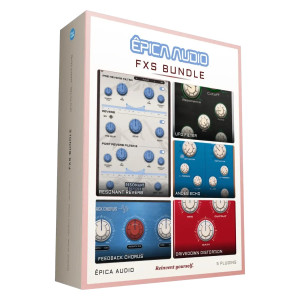
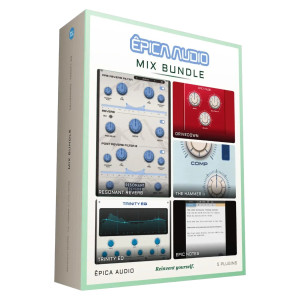
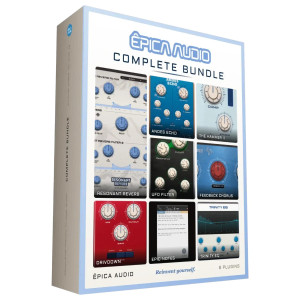
Pack Mix V2 gathers five mixing-chain plug-ins: Resonant Reverb, Trinity EQ II, Drivedown Distortion II, The Hammer Compressor III and Epic Notes. Fxs Bundle V2 groups five zero-latency effects, including Resonant Reverb, Andes Echo II, Feedback Chorus II and Drivedown Distortion II. Pack complet v2 goes up to eight plug-ins.
🎯 This choice is for you if...
- ✔ You mix your own tracks: the one-knob shapers deliver an audible result in seconds
- ✔ You record and mix in the same project: the zero-latency products stay inserted during the take
- ✔ You work across several systems: VST3, AU, AAX and LV2 on MAC OS, WIN and LINUX, the same chain follows you
- ✔ You want a reverb that is an effect: Resonant Reverb chains filter, distortion, plate and compression
What should you ask yourself before buying an effect plug-in?
Will the plug-in open in my setup?
The first criterion is compatibility: format (VST3, AU, AAX, LV2) and platform (MAC OS, WIN, LINUX). An AU plug-in will not open in a host that only reads VST3, and AAX requires an environment that accepts it.
Do I need the effect while recording?
Zero latency changes the use case: a latent effect is fine on a mix, but gets in the way on a take where the player listens through the plug-in. Trinity Eq II, The Hammer Compressor III and HI-FI claim that zero latency, as does Fxs Bundle V2.
Is one knob enough for what I do?
For an overall colour, a bus saturation or a stereo expansion, a single control is faster and avoids over-correction. For surgical work — removing one resonance, automating a movement — you need parameters, and the range provides them.
Buy single plug-ins or a bundle?
A single plug-in answers one identified need. A bundle makes sense when several of those needs coexist: five mixing plug-ins in Pack Mix V2, five zero-latency effects in Fxs Bundle V2, eight plug-ins in Pack complet v2.
FAQ - Epica Audio
Which plug-in formats does Epica Audio offer?
VST3, AU, AAX and LV2, as listed on the brand's product pages.
Which platforms do the plug-ins run on?
MAC OS, WIN and LINUX, bundles included.
Do the plug-ins add latency?
Several products claim zero latency and remain usable while recording: Trinity Eq II, The Hammer Compressor III, HI-FI and Fxs Bundle V2.
What is the difference between Pack Mix V2, Fxs Bundle V2 and Pack complet v2?
The first holds five mixing-chain plug-ins, the second five zero-latency effects, the third eight plug-ins covering filtering and saturation.
What is the Epic Notes plug-in?
A notepad built into the project: sketching ideas, writing down chords and lyrics, tracking takes, logging hardware settings.
Is the Joe Chiccarelli reverb just a reverb?
No: resonant filter and distortion up front, a plate with wide stereo image, an internal compressor inspired by the 1176, a second transparent filter, decay from 0.5 s to 47 s and 58 signed presets.
Are the Juno-60 and the 1176 reproduced under licence?
No. They are sonic references cited on the product pages, with no licence or partnership with the makers of those machines.