Cart
There are no more items in your cartOkaysynth
Bingo Drum Machine
Regular price 105,78 € 89 €
Insane beats in seconds. Tweak them for hours. Instant gratification. Infinite depth.
- -16%
Bingo is Okaysynth's drum machine, built to lay down a groove quickly inside the DAW.
Okaysynth releases Bingo, a software drum machine built the way hardware groove boxes are built: a step sequencer at the centre, synthesis underneath, and knobs that do what knobs are supposed to do. The wager is immediate handling, without giving up depth of control.
Bingo exists as a standalone version and as a plugin, so you can open it alone to hunt for a beat or drop it into an existing project. Its promise fits in one sentence: start an idea in a minute, then spend hours on it if you want to.
💡 Key takeaways
Because it decides how fast an idea turns into a beat. In Bingo each track has its own voice and its own effects chain, and the sequencer drives the whole thing step by step. You program, you listen, you nudge a hit by one step, and the track changes its breathing.
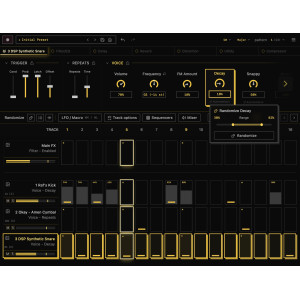
Parameter locking sits at the heart of the logic: any parameter can be fixed on any step. That is what turns a steady loop into a living pattern, without multiplying tracks or reaching for the DAW's automation.
A locked parameter can be swept by an LFO, and several parameters can be grabbed by a macro and driven live. That combination gives two scales of movement: step-by-step detail and overall breathing.
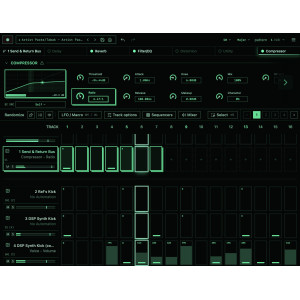
Each percussion has its own filter, its own amp envelope, its own delay, its own reverb and its own distortion. These effects are not reserved for the master: individual treatment is what gives every element its place and relief.
Six effects per track means shaping a short, dry kick, a long, wet snare, a metallic hat without smearing the rest. On many drum machines that work happens afterwards, at mixing; here it is part of programming.
Effects routing is chosen between the main output, a bus and the multi-out. Multi-out is decisive for anyone who wants to treat percussion in the DAW with their own plugins, while the bus lets several voices be grouped before treatment.
The 21 voices cover kicks, snares, hats, claps, FM metals, a 303-style bass, a plucked string and many other elements. Each track can also load its own samples, and the sampler offers granular and wavetable synthesis.
Scale locking keeps melodic voices in the chosen key. It is a valuable safeguard when hunting for a bass line or a held note: you can explore without falling out of tune.
MIDI export lets you carry a pattern to another DAW, and stem export means you are not locked into one tool. The sequencer can also drive external hardware over MIDI, which makes it the centre of a hybrid setup.
🎯 This choice is for you if...
That is the first thing to check, because it conditions plugin use. The product page lists the available versions, standalone and plugin; make sure your DAW supports the format offered before buying.
A software drum machine does not play the same role as a loop player. If your work consists of stacking ready-made loops, the value of the step sequencer and parameter locking will be limited. If you program your hits, it becomes central.
It changes the method: you decide each element's character while programming, instead of redoing everything at the mix. It takes a little more time at first and saves a lot afterwards, especially when a track holds many percussions.
MIDI export carries the pattern, stem export carries the sound. Those two outputs prevent lock-in and let you continue a project in another DAW, or hand the stems to an engineer.
It is announced as coming soon and does not replace the standalone and plugin versions: it extends use rather than substituting for it. For full production work, the computer versions remain the reference.
A software drum machine from Okaysynth, built around a step sequencer, with 21 drum synthesis engines and a sampler.
21 voices, covering kicks, snares, hats, claps, FM metals, a 303-style bass, a plucked string and other elements.
Yes, each track can load its own samples, and the sampler offers granular and wavetable synthesis.
Filter, amp envelope, delay, reverb and distortion, with six effects per track and main, bus or multi-out routing.
Yes, MIDI sequencing of external hardware is among the announced features, which lets Bingo act as the centre of a hybrid setup.
It keeps melodic voices in the chosen key, which avoids drifting out of tune while hunting for a bass line or a held note.
Yes, through MIDI export for the pattern and stem export for the sound, two ways of continuing work outside Bingo.
Yes, the standalone version exists alongside the plugin version: it can be opened alone, without a DAW.