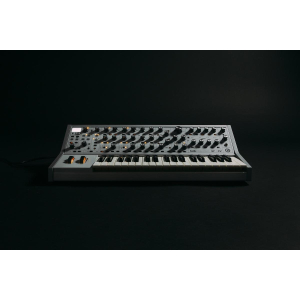
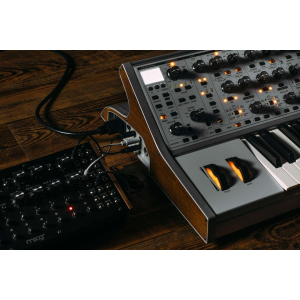
Synthesizers Moog are legendary for their rich and analog sound. At Green Musicians, our used Moog instruments allow you to own a piece of electronic music history, with the guarantee of unparalleled quality and sonic authenticity.
The Dawn of Synthesis: The Beginnings of Moog
The origins of Moog date back to 1964 when Dr. Robert Moog began production of the Moog Modular, a synthesizer that would forever change how musicians approach sound creation. This machine, with its multiple modules and dangling cables, was not just an instrument but also a vision of the future.
These early synthesizers, although bulky and complex, gave artists the power to create entirely new sounds. Recording studios worldwide quickly adopted this technology, and the Moog sonic signature became ubiquitous.
The Evolution of Moog: Journeying into the Sound World
As technology progressed, Moog kept pace. Flagship products like the Moog Minimoog paved the way for a new generation of portable and affordable synthesizers. This machine solidified Moog's position as an industry leader, quickly becoming a staple for producers and artists.
But what truly set Moog apart was its ability to constantly push boundaries. Each product brought a new dimension to music production. For example, the Moogerfooger system offered musicians a suite of analog effects, extending the range and diversity of available sounds.
On the Global Stage: The Influence of Legends
One of the most powerful testimonies to Moog's influence in music is the impressive number of iconic musicians and bands that have integrated their synthesizers into their sound. Among them, Pink Floyd were among the first to adopt the Minimoog, using it to enrich their psychedelic soundscapes. The album "Dark Side of the Moon," for instance, saw the band use the synthesizer to create atmospheric sound textures that have become emblematic of that era.
The Beatles, that legendary group, also embraced Moog's unique sound in tracks like "Here Comes The Sun" and "Because," showcasing the instrument's versatility. George Harrison in particular was fascinated by the sonic capabilities of the Moog and even used it for his solo album "Electronic Sound."
Another iconic group, Kraftwerk, is often cited as having redefined electronic music, and their love for Moog was well known. Their innovative use of Moog synthesizers laid the foundation for modern electronic music, merging technology and art in a way that had never been seen before.
The Digital Turn: From Animoog to Animoog Z
Enter the digital era. With the advent of smartphones and tablets, a whole new avenue opened up for electronic music. Moog, always at the forefront of innovation, released Animoog, the first professional synthesizer for iOS in 2011. This app changed the landscape of iOS music production, offering an innovative approach to dimensional sound design. The anisotropic waveform synthesis was unique, with an interactive touch interface that was both futuristic and intuitive.
A decade later, the culmination of this vision is the Animoog Z. This 16-voice polyphonic synthesizer, available for iOS and macOS devices, is a showcase of innovations. Its Anisotropic Synthesis Engine (ASE) uses an orbit system to expand upon wavetable and vector synthesis concepts. Dynamic navigation through the X, Y, and Z axes offers a scalable, layered, and fully immersive sound experience.
The Importance of Moog in Modern Music Production
But why are these innovations so crucial for today's music production? To begin with, Moog tools, whether their classic synthesizers or innovative applications like Animoog Z, offer an unprecedented sonic palette. Producers can explore uncharted sound territories, ranging from digital tones to analog waveforms captured from classic Moog oscillators. This sonic flexibility is essential in an increasingly diverse musical world.
Secondly, the user-friendliness. Intuitive interfaces, combined with powerful sound capabilities, make Moog products accessible to both professionals and enthusiasts. The ability to connect these tools to modern DAWs, thanks to plugins like AUv3, reinforces their usefulness in recording studios.
Moog: More than a Brand, a Revolution
Ultimately, Moog is not just a company or a brand; it is a revolution in the music world. At every stage of its existence, Moog has pushed the boundaries of what is possible, offering artists tools to bring their vision to life.
Whether you are a seasoned producer, an electronic music enthusiast, or simply a music lover, Moog's contribution to music is undeniable. From the iconic Moog Modular to the digital innovations of Animoog Z, Moog continues to inspire, challenge, and transform the musical landscape.
So, the next time you listen to your favorite track or explore the depths of a new synthesizer, remember Moog's legacy and vision. They are not just pioneers of the past; they are also shaping the future of music.