Cart
There are no more items in your cart


- Supplier Direct
- -17%
Flight builds one instrument and one only: the ukulele. Where plenty of makers treat it as a miniature guitar, Flight takes it for what it is — a complete instrument with its own sizes, its own tunings and its own repertoire.
The whole family is there: soprano, concert, tenor, baritone, electro-acoustic models, left-handed versions, ABS travel instruments, solid wood and laminate. Instruments that play straight out of the bag, with clean finishes and materials picked for real use rather than for a catalogue photograph.
At Green Musicians, Flight makes up the largest part of our ukulele catalogue, with more than 170 references — enough to compare sizes, woods and configurations inside one coherent family of instruments.
💡 The essentials
The range follows a player's progress. You change size, wood, sometimes configuration, without leaving the same family of instruments: neck feel, string tension and ergonomics stay consistent from one model to the next.
Every useful configuration exists: acoustic for practice at home, electro-acoustic for stage and studio, left-handed for players who refuse a flipped instrument, ABS for travelling light.
Then come the contact points: nut, saddle, tuners, frets. On a ukulele these four do more for playing comfort than any marketing argument you will read.
Size is the first decision, and the one people regret longest when it goes wrong: it sets the volume, the scale length, the spacing between frets and the repertoire the instrument quietly pushes you towards.
Around 21 inches and a short scale: the historical instrument, the one built for tight strumming and chords that snap. Bright, percussive, easy to carry. Its limit is well known: past the twelfth fret, melodic playing becomes uncomfortable.
Around 23 inches with better spaced frets: the concert keeps the soprano's colour while gaining volume and comfort for the fretting hand. It is the size we recommend most often to an adult who is starting out.
Around 26 inches and a wider body: the tenor projects, reaches lower and takes a Low G, a fourth string an octave down that gives fingerstyle a real foundation.
Around 30 inches and tuned D-G-B-E, like the top four strings of a guitar: this is the guitarist's ukulele, with familiar reference points and none of the bulk.
If you mostly strum chords while singing, the concert is enough and sounds closer to the classic ukulele. If you play melodies or plug the instrument in, the tenor brings the room and the projection the concert lacks.
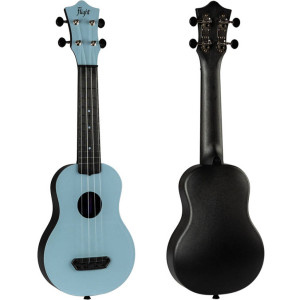
Wood is alive. It swells with humidity, shrinks when the air turns dry, and a solid ukulele left in a car or a heated room can crack. That is exactly the problem ABS resin solves: the instrument takes humidity swings without its structure working against you.
It sounds different: a more consistent response from one unit to the next, a shorter sustain, a slightly harder edge in the treble. But properly built and properly set up, it stays entirely musical.
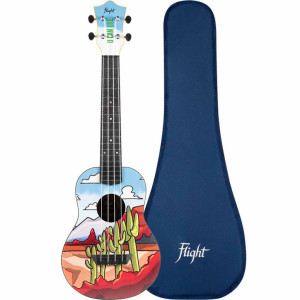
Travellers, campers, beach players, teachers carrying several instruments, parents buying a first ukulele. It is also the smart pick for an instrument that lives in a boot or moves from the cold into a heated room several times a day.
A plain acoustic ukulele disappears in a band. An electro-acoustic model solves that with an onboard preamp, a volume control and, depending on the model, EQ or a tuner.
Three-band EQ is the comfortable minimum: cut the lows that make the body boom, shape the mids so the voice sits on top, dose the treble. A built-in tuner saves silences between songs.
Feedback is a loop between the speaker and the instrument body. Three habits: pull the lows down on the desk, do not stand in front of the monitor, keep some distance. A high-pass filter around 100 Hz usually settles it.
A left-handed ukulele is not a right-handed one turned around. The left-handed version implies a coherent layout: matched nut and saddle, fretboard and bracing built for the opposite hand, a finish with no unused peg hole in the top.
String order, nut position, neck ergonomics and often the cutaway. On an acoustic, the top bracing has to stay balanced so the response does not shift to one side; on an electro-acoustic, the jack sits on the correct side.
Reversing the strings and turning the nut sometimes works, but the result is uneven: asymmetric bracing, a radius cut the wrong way, electronics on the wrong side. For an instrument meant to last, the factory left-handed version is the right answer.
A new ukulele goes out of tune: strings stretch, wood settles, tuners bed in. That is normal for the first weeks. A few simple habits then keep it stable for years.
Soprano, concert and tenor tune to G-C-E-A. The tenor often takes a Low G, an octave down on the fourth string. The baritone is tuned D-G-B-E. Always tune up to the note rather than down: the string holds pitch better.
Aim for 45 to 55 % relative humidity, keep it away from radiators, sun-baked cars and over-dry rooms in winter, and store it in its bag. A case humidifier costs little and prevents the crack that costs a great deal.
🎯 This is the right choice if...
Not necessarily. The soprano is the historical format, but an adult beginner often feels cramped on a short scale. The concert offers the same character with roomier frets. The real criteria are the size of your hands and the music you want to play.
Yes, as long as you pick the size: a soprano works from about seven or eight, a concert from about ten. A child should hold the instrument without the neck diving. An ABS model survives the drops.
Laminate is more stable and cheaper, which makes it an excellent first instrument. Solid wood sounds richer but needs steady humidity. For a beginner who does not yet know whether they will still be playing in two years, laminate is the prudent choice.
They arrive close to pitch, but shipping always unsettles new strings. Keep a tuner handy and give the instrument a week: a ukulele that drifts out of tune in the first days is settling, not faulty.
A guitalele is a six-string hybrid in tenor size, tuned like a guitar a fourth higher. The baritone remains a four-string ukulele in D-G-B-E.
An acoustic without a preamp is miked up, which is still the most natural solution in a studio. For live work, an electro-acoustic model avoids placement and feedback problems.
Less than wood, but it is not indestructible: hard cold stiffens strings and throws the tuning out while the instrument acclimatises. Let it come back to room temperature inside its bag before you play.
Look at the nut and the saddle: on a factory left-handed model the wider slot sits on the opposite side from a right-handed one. The simplest clue remains the saddle, whose position is calculated for string compensation in one precise direction.